
The Java Train
a railroad journey across the historic heart of Indonesia

The train to Yogyakarta, Central Java, departs Jakarta in the early morning. To make it in time, you have to leave home when the sky is still dark and the tree sparrows are not yet awake, and the endless winding streets are packed with taxis carrying sleepy civil servants and workers on mopeds. Sometimes the traffic backs up behind street-food vendors pushing handcarts transformed, Red Green style, into makeshift portable kitchens for cooking meatball soup.
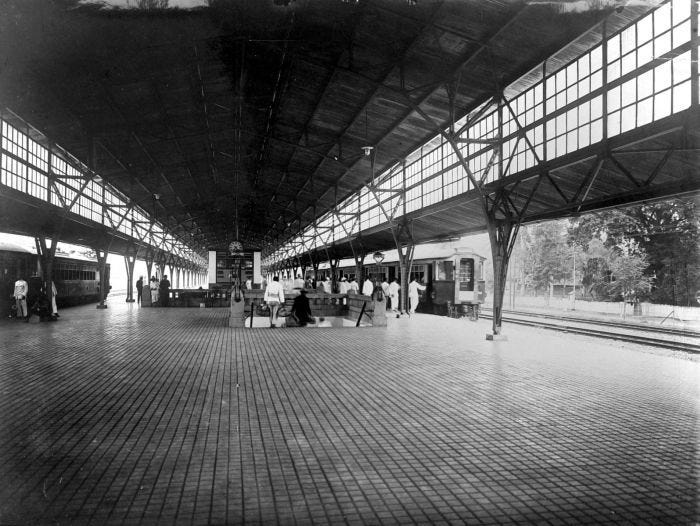
The station itself is an impressive work of colonial architecture from the 1920s, built during the final epoch of the Dutch empire. Railway journeys are still a common method of long distance travel in Java, where a majority of people don’t own cars. Whole families stand at the station- stout women in hijabs wrangling unruly kids, lanky mustachioed men, dignified elderly gentlemen in batik shirts and neat black caps, all on their way to meet relatives in distant villages scattered across the immense length of this ancient island, the most populous in the world.
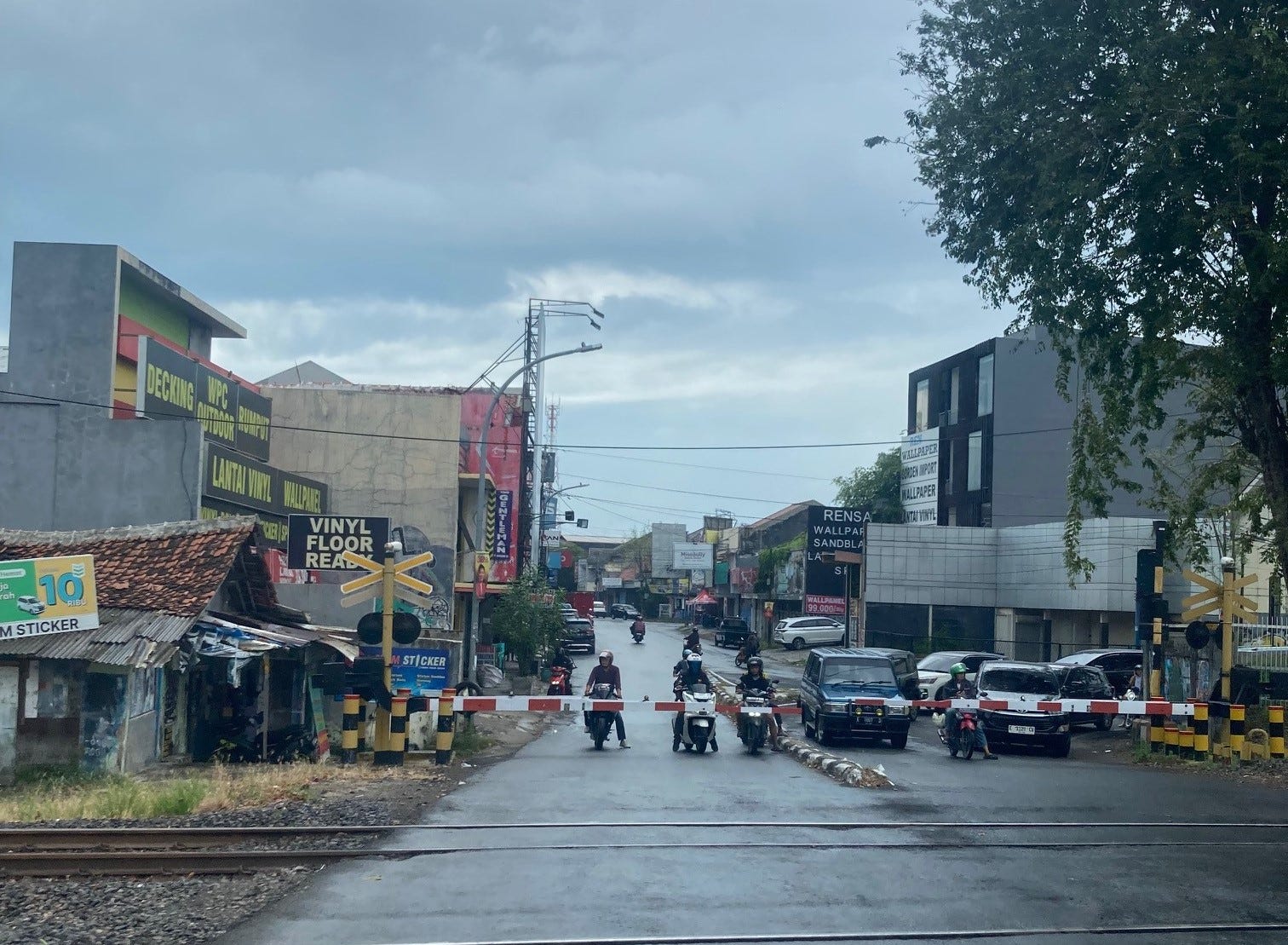
For the first hour or so, the traveler is treated to a backstreet view of Jakarta city - one of the world’s largest and one of Southeast Asia’s oldest- the former Batavia, headquarters of the Dutch East India Company. Little of that history is visible along the railroad track, where the poorest of the poor have built shanties of corrugated tin and ragged cloth. We pass freight yards and junk yards, empty lots and the decrepit back walls of otherwise respectable businesses. At railway crossings, rivers of motorcycles and blue minibuses (Indonesia’s most popular public transportation) cue up behind the barrier. The Jakarta region is after all home to more than 32 million people!
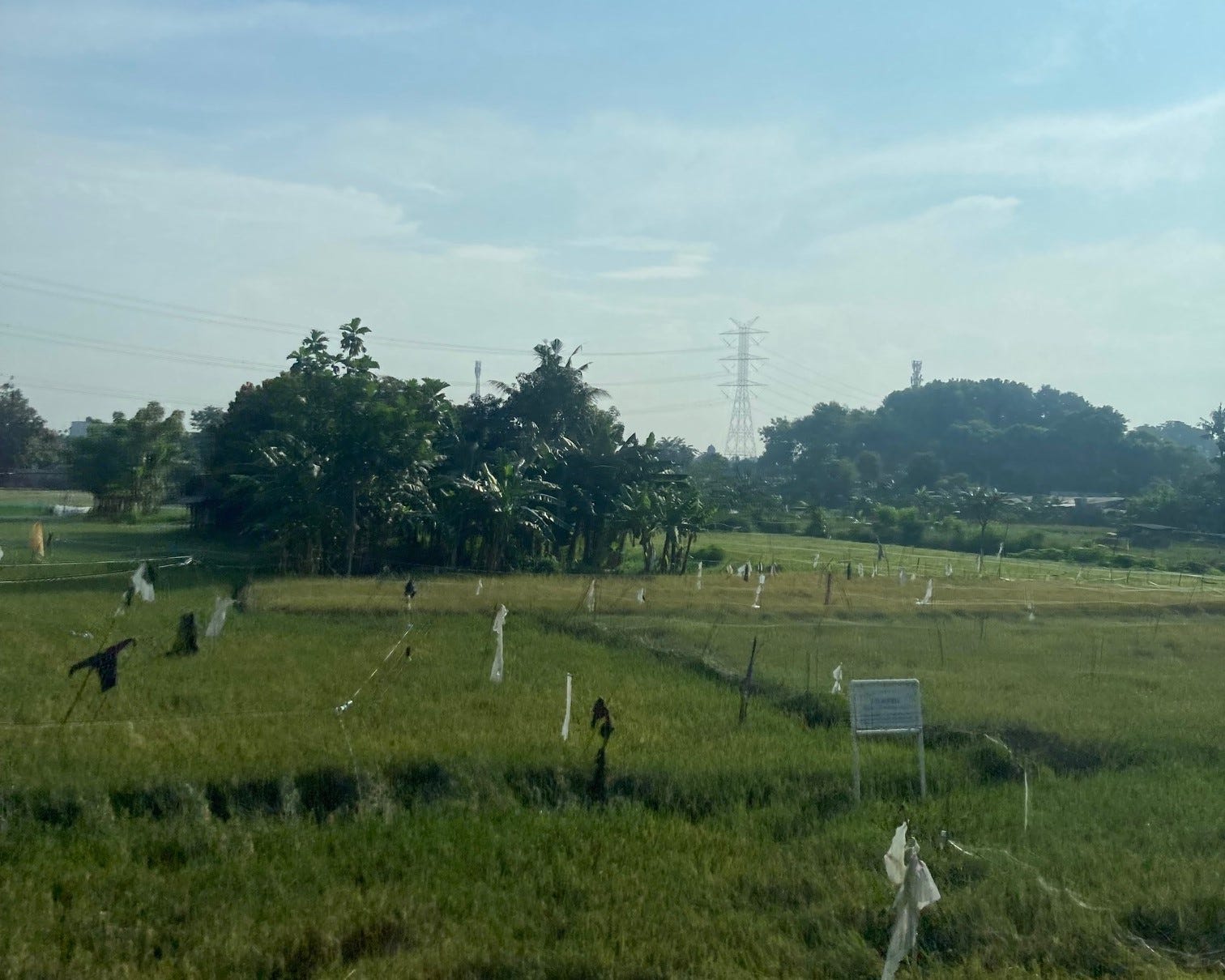
Gradually, grey urban sprawl is overtaken by bright green rice fields, and the background scenery of office blocks and apartments fades into the hazy distance. A few white herons flap lazily by. Within a couple of hours, the fields fill most of the landscape, with groups of houses or the occasional factory nestled among a patchwork of varying shades of green.
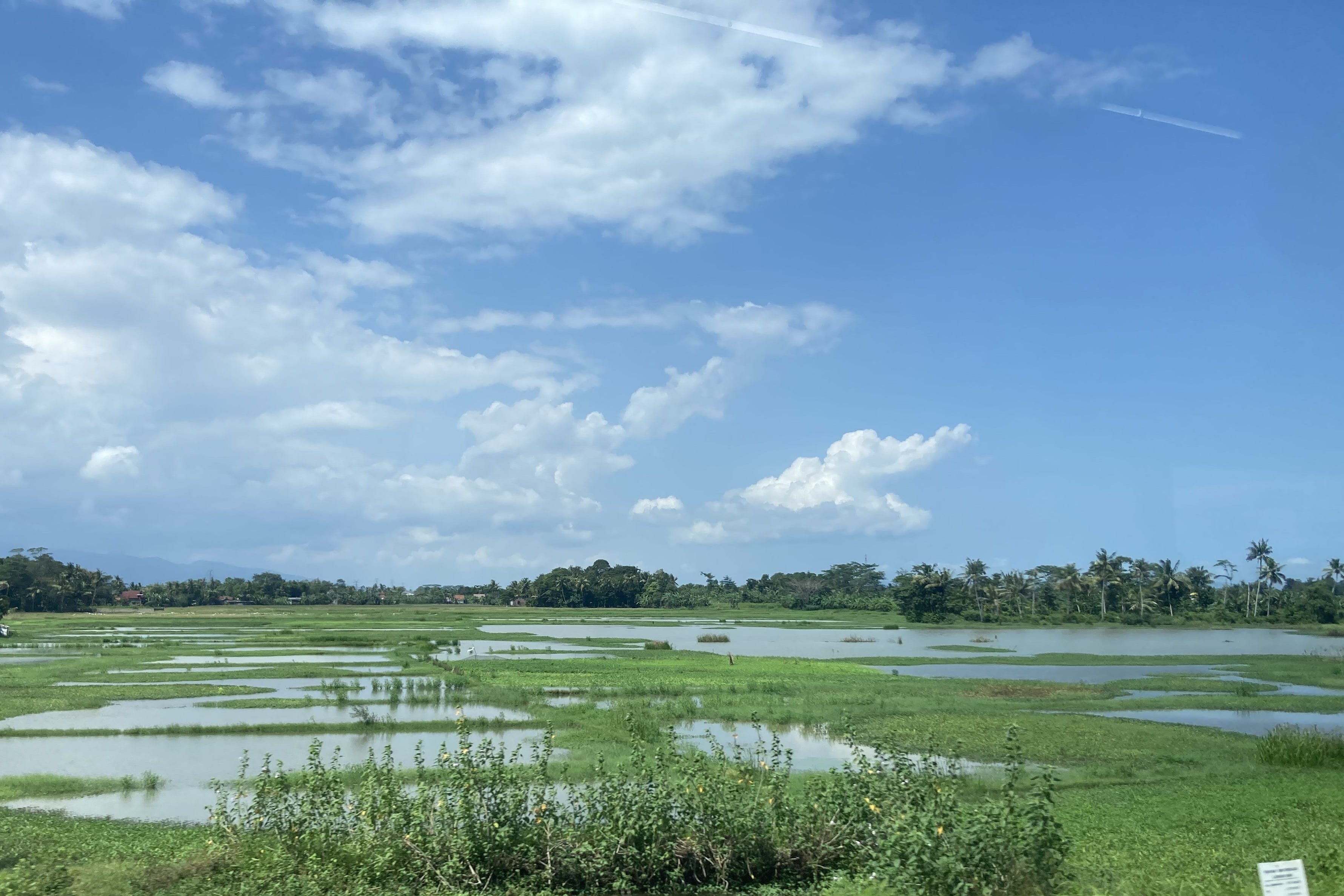
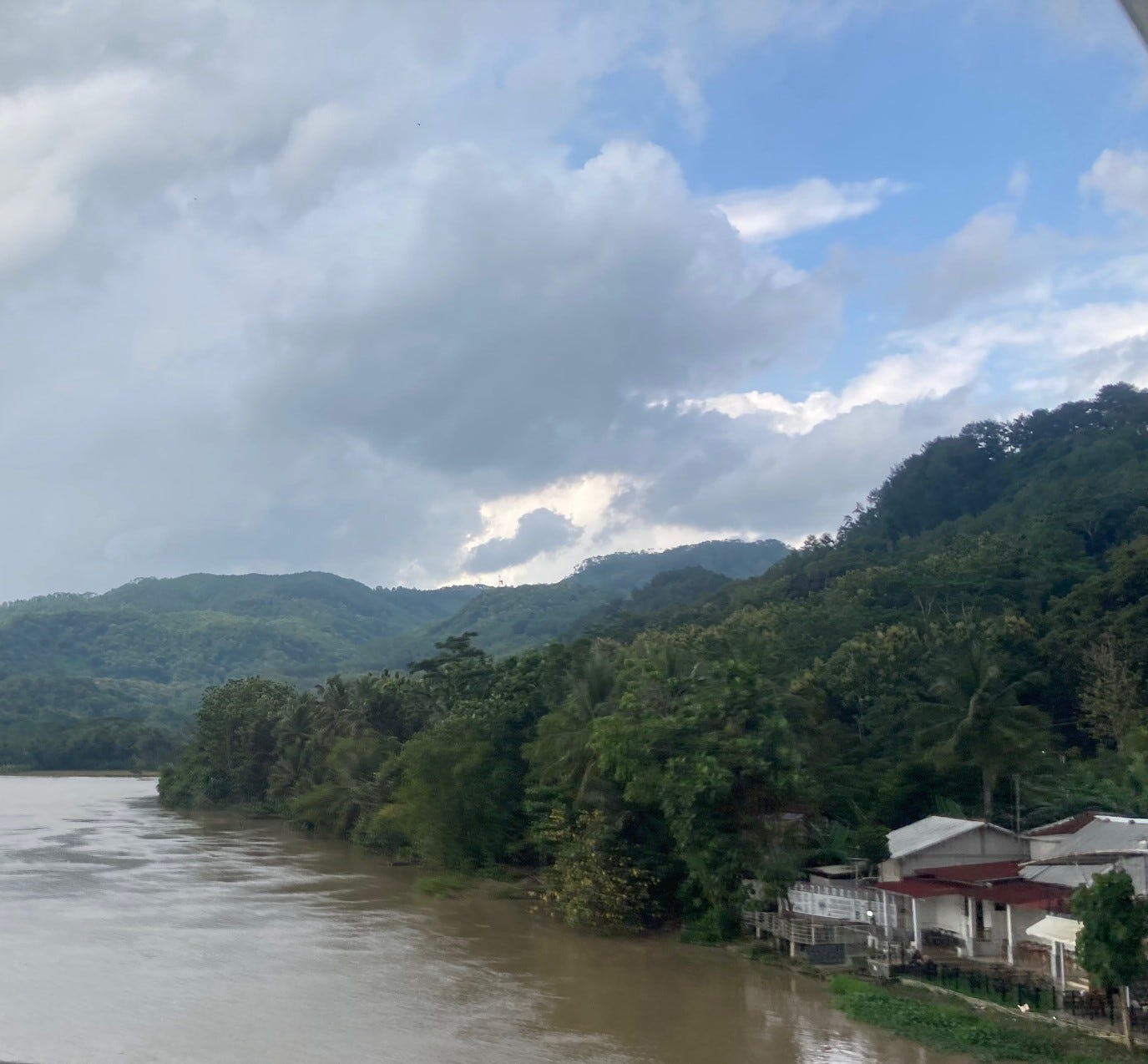
The route follows for many miles the great plain of Java’s northern coast. This is swamp country, once the haunt of crocodiles, now perfect for growing rice. The landscape is like a green sea of rectangular fields; tree-encircled villages seem to float among them like islands. Like the North Sea pastures of the Netherlands, rice paddies here are only borrowed from the marsh, and sometimes they are taken back- sodden fields sinking into dark mires. Occasionally we cross a great muddy river, houses on stilts lining the banks. The track doesn’t follow the big toll highways that link Jakarta to Java’s numerous cities- it rolls through endless fields, past isolated villages and muddy dirt roads. In one dusty courtyard an old man in a ragged shirt and turban sits on a broken chair , cigarette dangling from his lips, just watching the train roll by.
The harvest is in progress- in this rich soil and eternal warmth, crops can be planted several times a year. Many farmers still use traditional tools- short, sharp hand scythes- for reaping, although the buffalo-drawn wooden plow has largely been replaced by the hand tractor (a sort of supersized rototiller). Typically for Indonesia, men and women work together, cutting and bundling the stalks, and carry the bundles to little threshing machines- a small concession to modernity, if modernity was the 1980’s. Herons and egrets flock around them, eager to snap up small animals disturbed by the harvest.
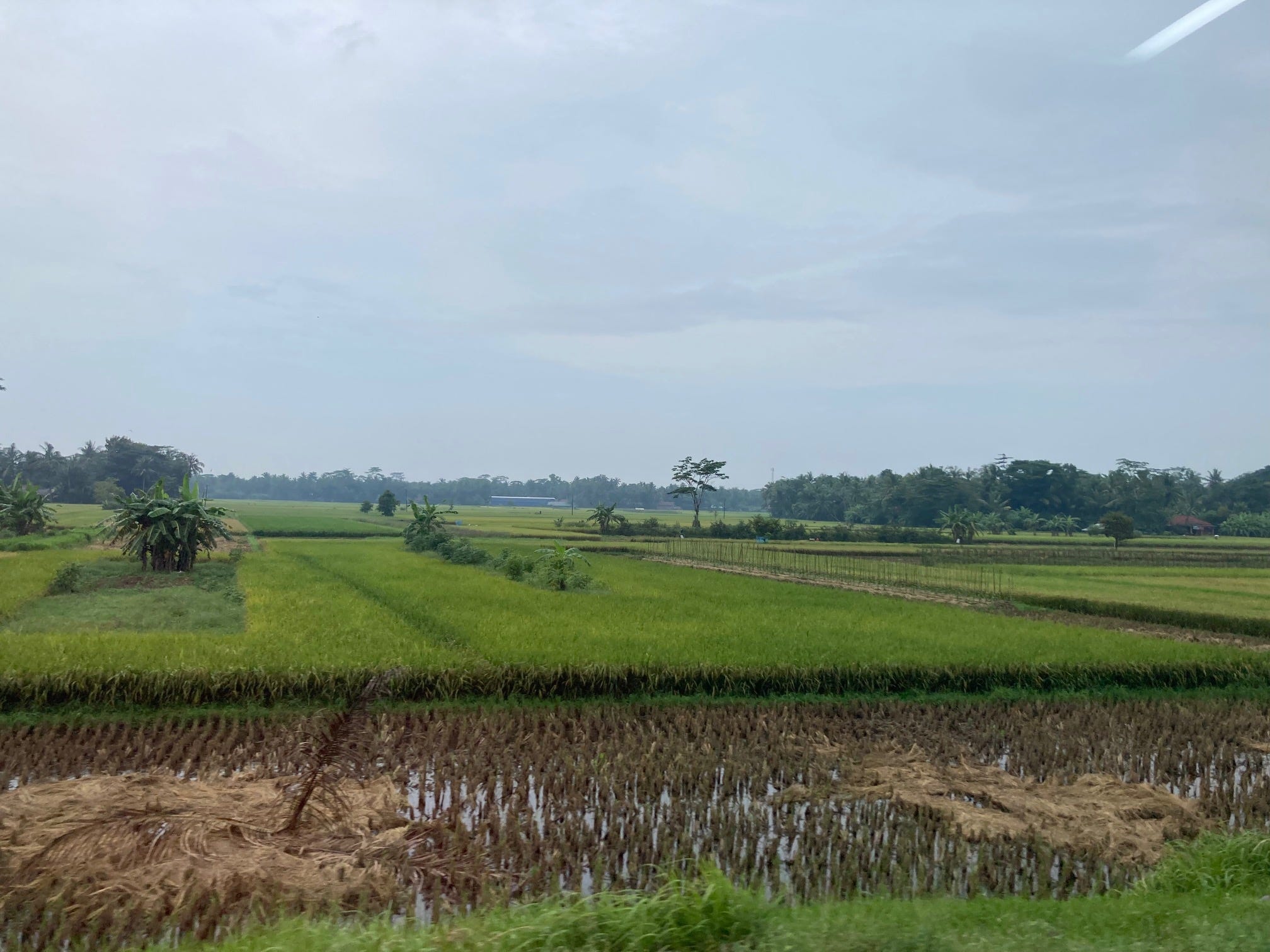
After threshing, the stalks of rice are piled in great heaps across the fields and burned- a practice ‘climate-conscious’ Westerners might frown upon, but which helps to quickly return nutrients to the soil. In other fields nearby, fresh green shoots rise from the muddy ground.
We stop briefly at several stations along the way, including the coastal city of Cirebon, a crowded shipping port. For centuries an independent sultanate and international center of trade attracting merchants from China, India, Arabia and Europe, the city is now famous across Indonesia for its traditional Batik cloth. Located along the rich, shallow waters of the Java Sea, it is also a major producer of all things shrimp- shrimp paste, shrimp crackers, dried shrimp…. you get the idea.
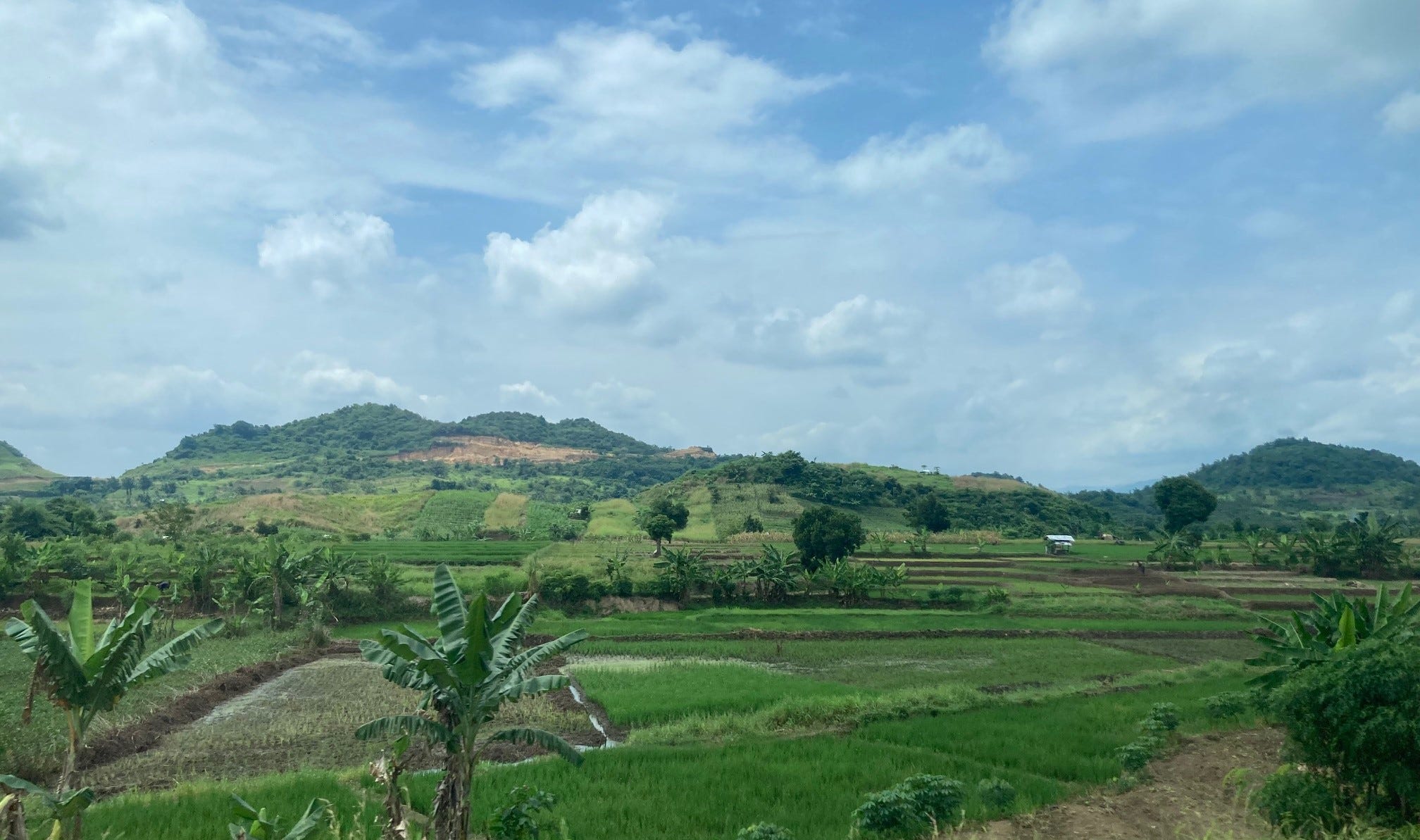
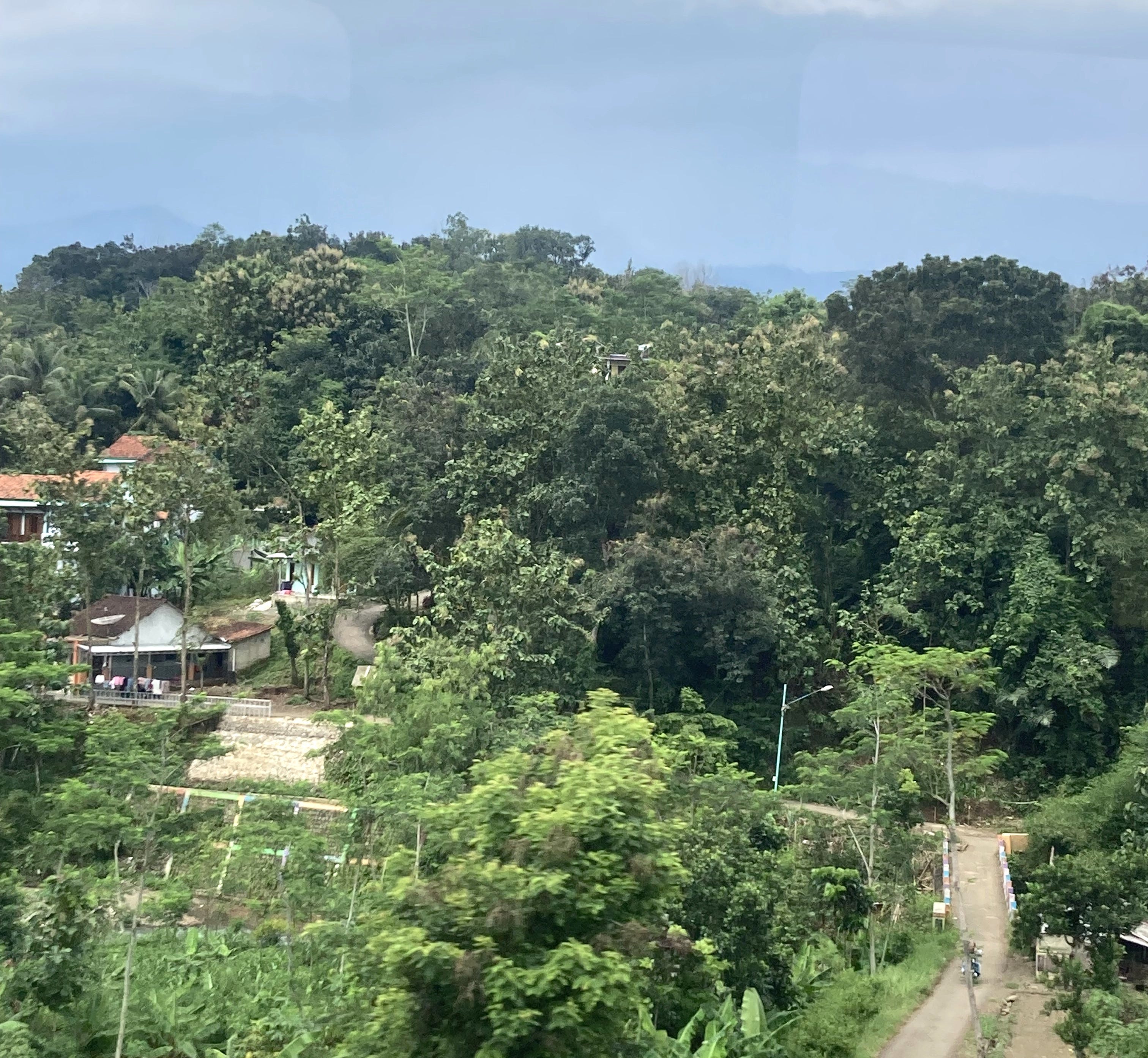
Eventually the track turns- southwards and upwards, slowly climbing into low hills covered with mixed forest and fruit tree gardens- bananas, mangoes, jackfuit. Flat flooded fields are replaced by a classic Southeast Asian landscape of raised terraces. Terracing may have originated in India, arriving in Java along with Hinduism in the early centuries AD, and it remains one of the most efficient systems of irrigation in the world. Channels, which can be plugged or moved when necessary, direct water down the sculpted hillside. On the raised edges separating each terrace level, farmers grow taro, cassava and corn; stands of bananas and other fruit trees are interspersed throughout. The flooded fields are an ecosystem of their own, providing habitat for birds, amphibians and numerous aquatic insects- an environment now increasingly threatened by intensive harvesting and pesticide use.
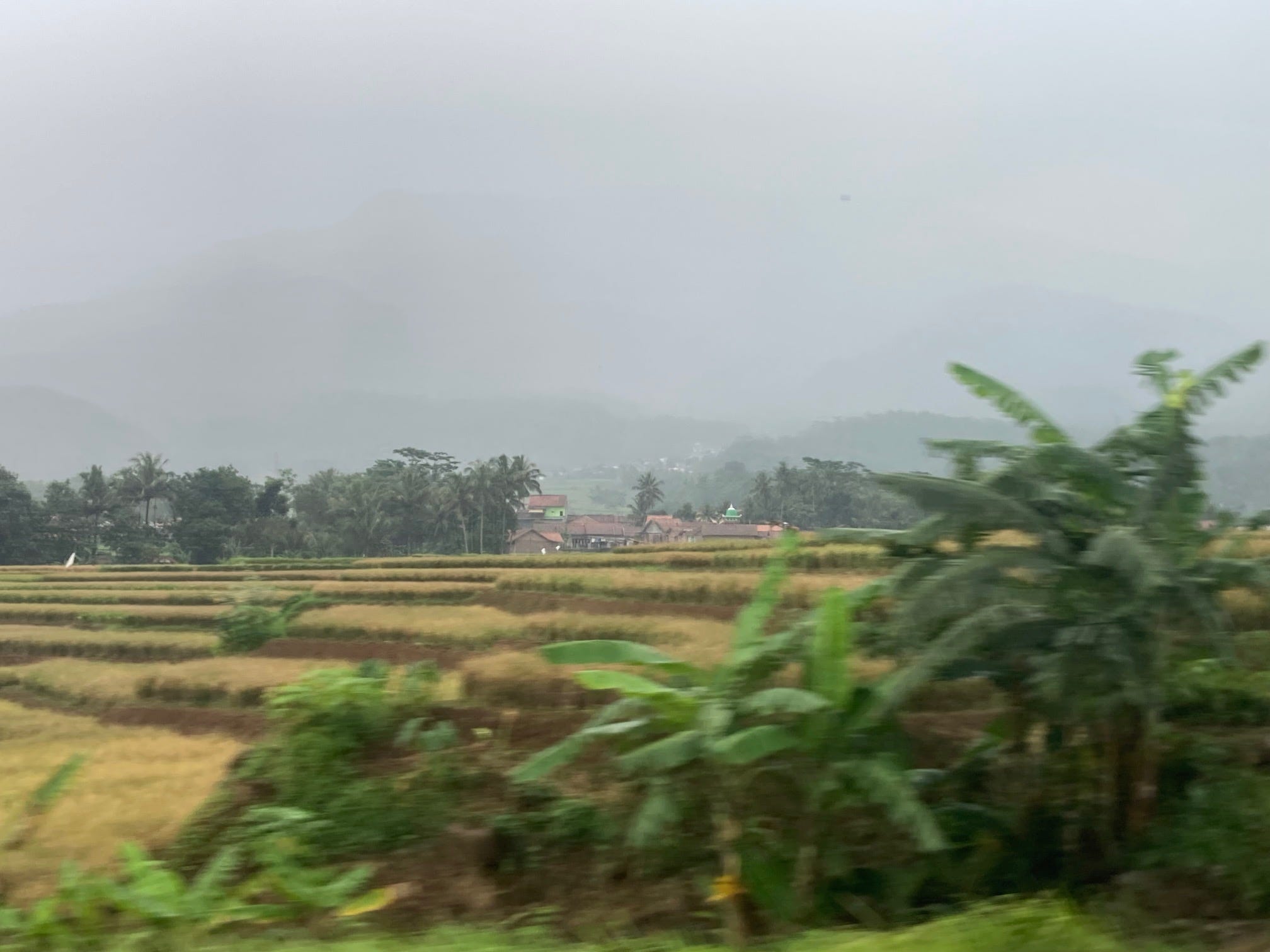
Despite being located on an island of more than a hundred million of people, the villages here are profoundly isolated, nestled in the midst of their fields, situated far from the main road; many don’t have a train station- the train and the highways just keep going. If you want to get to the nearest city, you have to ride your moped or dirtbike (standard Indonesian transportation) miles down the narrow unpaved roads. Every town has a school, a mosque, a few little stores. I see women hanging laundry, children kicking a ball in dusty courtyards, men resting in the shade of mango trees. In the days before phones and internet, a community could live here, day in and day out for generations, knowing little, and caring less, about the outside world. This region is often considered the heart of traditional Javanese culture, preserving age old customs and beliefs forgotten elsewhere. Even today, some farmers still perform harvest ceremonies in honor of the Rice Goddess Dewi Sri, a deity who seems to have roots reaching back to the very beginnings of agriculture in the Neolithic era.
Gazing out the window, watching the little clusters of red-roofed houses pass by, each in its own shadowing forest of fruit trees among the yellowing rice fields, I seemed to be traveling in time; images of the past flashing by the windows of this great mechanical contraption roaring on at 60 miles an hour. Communities here live in a way all but incomprehensible to most people today- including many young Indonesians.
And yet, the apparent timelessness is only a half truth. Things are changing here too. An increasing number of the young people now leave to work in Jakarta or abroad, sending money back to relatives at home. Once a year, on the national holiday of Lebaran (around the end of Ramadan), millions of Indonesians return to their home villages, causing traffic jams on a truly mind blowing scale. Jakarta is miraculously empty, and villages are once again buzzing with life. A week later, they all go back to work in shops or offices, and the villages go quiet again.
Not long ago, most of Indonesia’s population lived and worked around such villages, planting, harvesting year after year, fishing and washing clothes in the river, eventually to be laid to rest in a quiet cemetery among the rice paddies, to sleep after a lifetime of toil, awaiting the blissful gardens of Paradise. A fragrant frangipani tree grows from the head of every grave. The entire cycle of being is played out here- the home, the mosque, the school, the cemetery. Death is not hidden away here- neither is life. For all the modern world has gained, through advanced education, technology, medicine, something has in turn been bargained away- a closeness with reality, with the earth, the substance of life. But the door is always open- as Wordsworth said, ‘come forth into the light of things, let nature be your teacher’.
I love the poetic style of your writing. Your descriptions and thoughts comparing the present and the past, different cultures and different countries are interesting and thoughtful.
Absolutely beautifully descriptive writing about a world most of us know nothing about! I learn so much from your intelligent, witty and loving commentary!